
A value near the top of a lottery field can look less familiar than a birthday number, but familiarity does not change its role in a fair draw. Ultra Lotto 6/58 selects six main values from 58. Every permitted label participates in the same combination structure, while a complete six-number match is a much narrower event than any one label appearing.
A useful interpretation of ultra lotto 6/58 odds separates those events. It begins with one fixed valid six-number selection in one draw, then distinguishes a full main match, a single selected value appearing and a precise partial overlap. Each statement needs its own count and label.
The full main match has a combination denominator
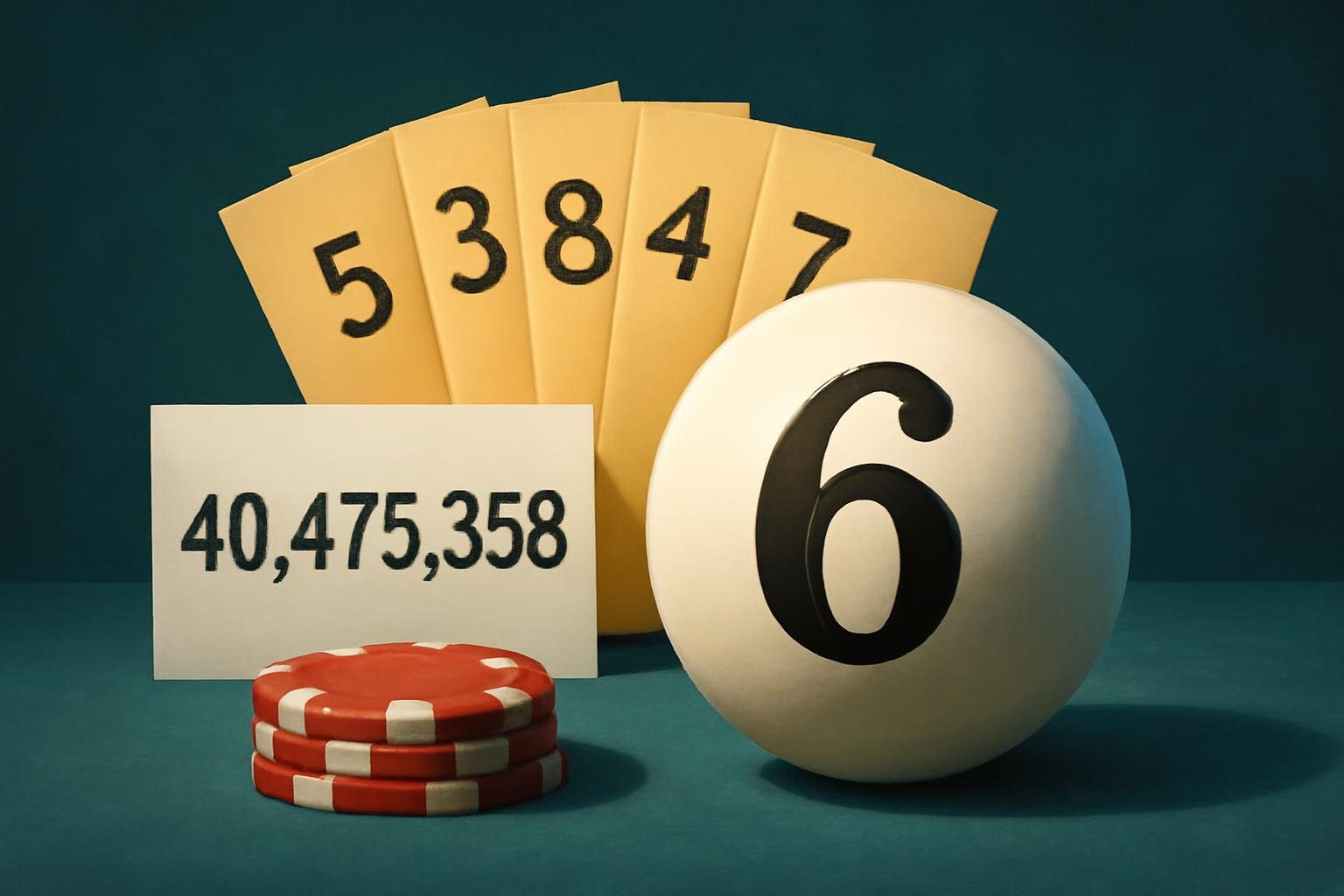
There are 40,475,358 different six-number subsets of a 58-number field. A particular valid basic line has a one-in-40,475,358 chance of matching all six main values in a fair draw. Different display orders of the same members do not create new combinations.
The field size matters to this result. A six-number line from another game can use a different upper limit and therefore a different denominator. A comparison should preserve both the six-value selected count and the 58-value field rather than assuming all six-number lotteries have equivalent main-match chances.
One value appearing is a broader event
For any fixed permitted label, the chance of appearing among the six main winners is six in 58 under the fair model. This statement is the same for a low label and the highest permitted label. It does not depend on whether the number is personally memorable.
That probability is not the chance of a complete six-number line winning. A line contains several specified values, and the full main event requires all six together. Replacing a complete-set probability with the much broader single-value fraction would omit most of the required conditions.
Several values appearing require a joint event
The chance that two specified labels both appear is not obtained by treating their appearances as independent with replacement. The draw selects distinct values. Once one label is included, the remaining selection structure changes the conditional count.
This is why combination counting is more reliable than multiplying casual one-number estimates. A set model respects the no-replacement structure and keeps exact selected counts intact. The same principle applies when moving from two specified values to a complete six-number line.
Partial matches need winning and non-winning choices
For exactly a given number of main matches, choose the matching values from the six main winners and the remaining selected values from outside that winning set. Both components are necessary to describe a complete selected line.
An at-least statement combines exact overlap events. An any-prize statement uses the qualifying conditions in the current official prize table. The award definition should remain attached to the probability, since a raw count of familiar values is not enough to establish prize eligibility or a net result after costs.
Larger fields do not change individual fairness
A larger upper limit increases the number of possible six-number sets. It does not make a particular retained value intrinsically unlucky. Every permitted label keeps the same role within that game's fair field, and every particular valid complete set keeps the same complete-match chance as another.
Historical frequency can describe a finite archive without changing those next-draw roles. Apparent hot or cold values do not create a requirement that an independent future draw compensate for past appearances. A selected pattern remains a preference unless there is evidence for a different draw model.
Keep collections and repetitions explicit
Distinct six-number sets in one draw cover distinct possible complete main results. Repeating the same set in another order adds no new main-result coverage. Repeated independent draws require a separate at-least-one calculation and do not guarantee a success after a fixed number of attempts.
A useful counting exercise fixes one permitted label and asks how many six-number sets contain it. The other five members can be selected from the remaining 57 values. Repeating that argument for another label gives the same count, which explains the equal role of low and high labels without relying on intuition about birthdays. It also shows why a line containing 58 is not disadvantaged merely because the label is large. The complete six-member condition remains much narrower than the single-label event. Keeping those two counts separate prevents a convenient one-number fraction from becoming a misleading estimate of a full match.
Potential prize amounts can change while the matrix remains unchanged. The practical reading of Ultra Lotto 6/58 probability is to state the field, selected count, event and unit before interpreting the figure. That makes the equal role of individual labels compatible with the rarity of a complete match, without turning either fact into a prediction.